
 サイトマップ
 各課のご案内
 施設のご案内
 お問い合わせ
Animals of the Mountain Rivers
From the steep mountains runs the Tedori River, whose rocky beds make homes for many creatures.
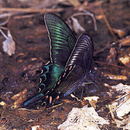
Alpine Black Swallowtail Butterfly
Papilio maackii
This species of swallowtail butterfly has a wingspan of 12 to 14 cm (4.7 to 5.5 in). It overwinters as a pupae, emerging in spring or early summer, and lives for only several months. They can often be seen drinking water from sandy riverbanks.
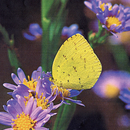
Common Grass Yellow Butterfly
Eurema hecabe
This butterfly is a small species of pierid butterfly, and can be found flying around grasslands and forests from spring to late autumn. During winter the butterflies will overwinter in their adult form. This butterfly can also be found throughout Asia, Africa, and even Australia.
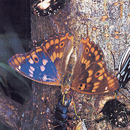
Freyer's Purple Emperor Butterfly
Apatura metis
Named after the male's wings, which appear purple under certain light, these butterflies can be found living by groves of willow trees throughout Europe and Asia. The caterpillars feed off of species of willow, and the adult males sometimes drink sap from the trees.
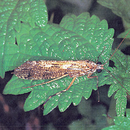
Higenagakawa Caddisfly
Stenopsyche marmorata
The Higenagakawa Caddisfly, which translates as the ‘Long Bearded River Caddisfly,’ lives in the mid to downstream area of clean rivers. The nymphs are aquatic, and spin silk nets between rocks to catch food. They then bury themselves into sand to pupate. Adults emerge from April to November.
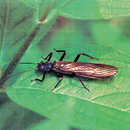
Oyama Stonefly
Oyamia lugubris
The Oyama Stonefly is a Japanese species of stonefly that can be found in clear mountain streams. Stoneflies are intolerant of water pollution, so their existence indicates the pristine quality of the Tedori River. The insect nymphs are aquatic, and live underneath rocks in the river. Stoneflies spend most of their life as nymphs, living only a few weeks as adults.
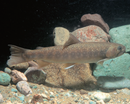
Char
Salvelinus
Out of all freshwater fish, the Char is known to live in the most upstream areas of river systems. In Ishikawa Prefecture the whitespotted char (Salvelinus leucomaenis) can be found. Called “Iwana” in Japanese, they're a very popular fish for cooking over hot coals.
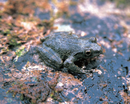
Kajika Frog
Buergeria buergeri
The Kajika Frog, endemic to Japan, is known for its beautiful call, similar to that of a deer. They can be found near mountain rivers and lakes, and typically lay their eggs beneath rocks. Recently their numbers have declined due to the construction of dams.
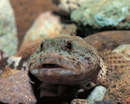
Japanese Fluvial Sculpin
Cottus pollux
A species of cattidae, this fish is endemic to Japan, and can be found in mountain rivers and streams. It has a maximum length of 15.0 cm (5.9 in). Eggs are laid in clean water, attached to rocks, where the males will protect them until they hatch. In Ishikawa Prefecture it is known as “Gori” and has been a local food for hundreds of years. However, due to a recent decline in the population caused by the construction of dams, it is no longer eaten as commonly.
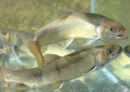
Spotless Char (City-Designated Natural Monument)
Salvelinus leucomaenis pluvius
Within the species of the whitespotted char, is this sub-species that actually has no spots! Said to be only found in the foothills of Mt. Hakusan, this small group of char seem to have evolved specifically to the local environment. Fishing the spotless char is prohibited throughout the year.
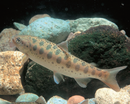
Red-Spotted Masu Salmon
Oncorhynchus masou macrostomus
Said to be the most beautiful of the freshwater fish, the red-spotted masu salmon inhabits cold upstream areas of river systems throughout western Japan. It is characterized by its spotted appearance, often with red colorations.
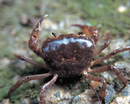
Japanese Freshwater Crab
Geothelphusa dehaani
Living in clean, upstream areas, the colour of this crab varies by region, from browns to blues to yellows. It eats small insects and worms, as well as plants and fallen leaves. They can often be found hiding under rocks by the river.
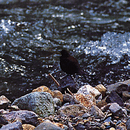
Brown Dipper
Cinclus pallasii
With a total length of 22cm (8.7 in), this aquatic songbird can be seen in mountain streams all year round. The brown dipper eats aquatic insects from the river, either by wading in the shallows or diving into deeper water.
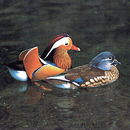
Mandarin Duck
Aix galericulata
Known for the beauty of the male's foliage, they have a maximum length of 48cm (18.9 in). Several flocks can be seen throughout the Tedori Gorge from autumn to winter. In summer only a small number of ducks can be seen.
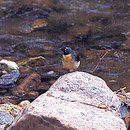
Grey Wagtail
Motacilla cinerea
With a total length of 20cm (7.8 in), these wagtails can be seen in the mid to upper stream areas of the river. Although visible throughout the entire year, many wagtails choose to migrate to warmer areas during winter. They're quite territorial, and can often be seen chasing other birds.