 サイトマップ
 各課のご案内
 施設のご案内
 お問い合わせ
The Formation of the Tedori River Alluvial Fan
The people of this land, while knowing of the dangers of the violent Tedori River, lived alongside it in order to receive its blessings. So, why are we able to receive such blessing? Let's learn about the connection between the Tedori River and the Tedori River Alluvial Fan.
The Formation of the Tedori River Alluvial Fan
The bedrock surrounding Mt. Hakusan is extremely volatile, and large amounts of snowmelt run through this eroding landscape, into the Tedori River. Sometimes the input of rain and snowmelt can cause flooding, whose rapid current carries with it large amounts of sand and stone, depositing them further downstream. From this still continuing cycle a beautifully symmetrical alluvial fan has been, and is being formed.
The History of the Alluvial Fan
The Tedori River Alluvial Fan is known as one of Japan's top 100 alluvial fans. Its beautiful near-perfect fan shape was formed by the relationship between Mt. Hakusan and the Tedori River. Let`s learn about how this alluvial fan came to be.
Appox. 2 Million Years Ago
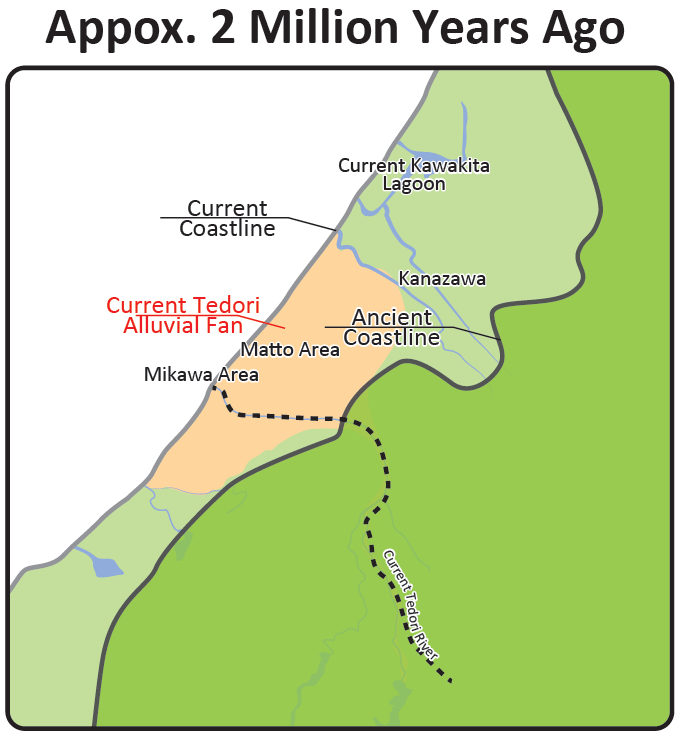
At the time, the location of the present alluvial fan would actually be underwater. A small cove developed by the sea, where a small alluvial fan appears to have developed. But the location of the Tedori River is unclear.
Approx. 70 - 100,000 Years Ago
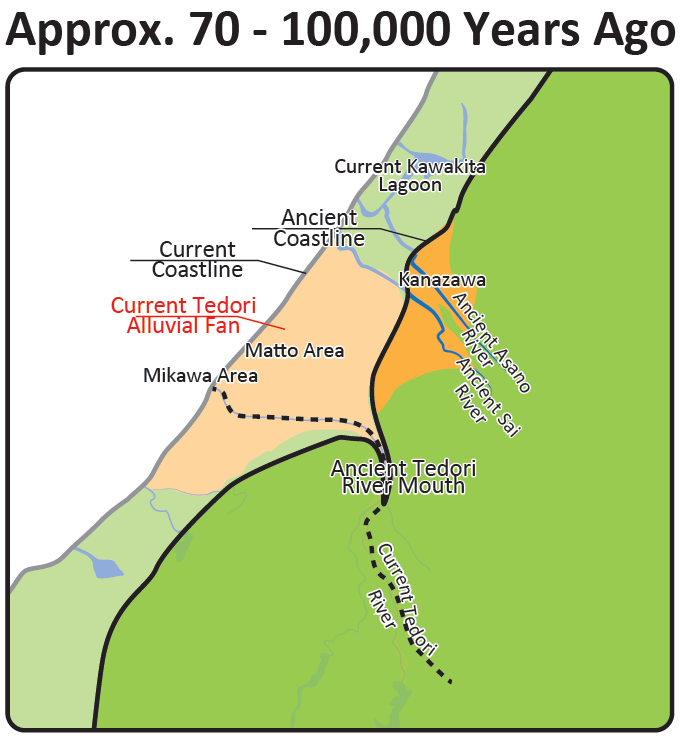
The coastline gradually moved out, and the mouth of the Tedori River became clearer. However, it's estimated that the river mouth was located near present-day Tsurugi (near Tsurugi Station).
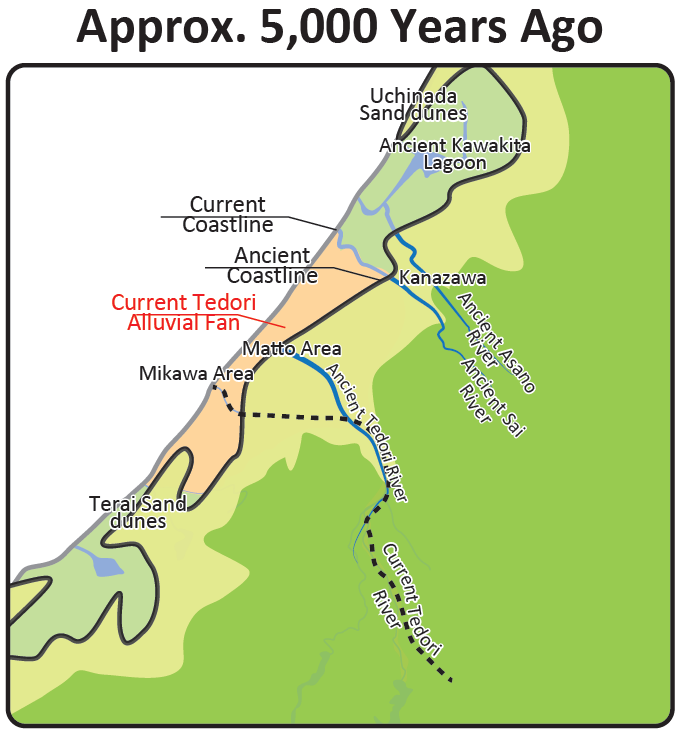
Approx. 5,000 Years Ago
Most of the sediment of the Tedori River Alluvial Fan was deposited during this time. As the coastline continued to shift back and forth, the shape of the fan was created.
Characteristics of the Fan
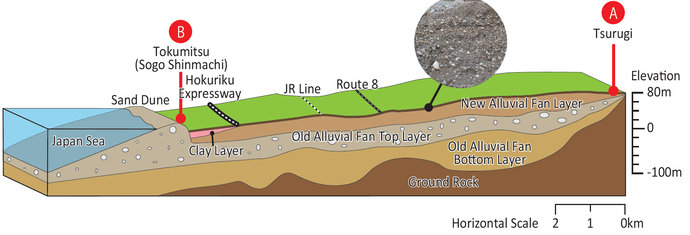
The Tedori River Alluvial Fan, starting from the Tsurugi area, spreads out at a roughly 100 degree angle. It has a length of 15km, a maximum width of 19km, and an area of 117km2. The highest point of the fan is approximately 90m above sea level. A large portion of the fan is used for rice paddies, and the area is abundant with groundwater.
Present Day
The Tsurugi area marks the head of the fan, with the ends of the fan being directly eroded by the sea.