
 サイトマップ
 各課のご案内
 施設のご案内
 お問い合わせ
Distribution Economy
In the following exhibition you will find stickers on each panel, corresponding to the relevant sections below.
Feel free to tap the section(s) you wish to view from the menu above.
P1: Development of the Distribution Economy
From the Edo Period and into the Meiji Period, transportation was conducted on land via horses and carts, and transportation via ships was thriving.
Afterwards, horse-pulled carts were used for transport, but with the establishment of railways, the opening of the Hokuriku Line, and further improvements in railways, on-land transportation increased, hugely influencing the transportation of goods by ship.
P2: Route and Ports of the Kitamae-bune Ships
Battling the rough waves of the Sea of Japan, kitamae-bune trading ships flourished, travelling from Esashi and Matsumae in the north, via the Seto Inland Sea to Osaka in the south. A number of shipping wholesalers developed at each of the ports along the way.
The ships picked up clothing, daily goods, sugar, salt, etc from along the Sea of Japan coast when heading north, and rice, timber, seafood, etc, when heading south.
In Matto, the direct cargo port Sougo Shin-ura was used, and lime, fertilizer and timber were unloaded.
Pictured is the route the ships took, and the main ports that were visited along the way.
>>You can learn more about the Kitamae-bune at the “Roots of Ishikawa Museum” in Mikawa, Hakusan City.
P3: Railway Map
Pictured is a railway map of the area.
- The top black and white line is the JR Hokuriku Main Line. The line between Mikawa and Kanazawa opened in 1898, and is still running today. The current line runs from Maibara (Shiga Prefecture) to Kanazawa.
- The right black line is the Hokuriku Railroad Ishikawa Line, it opened in 1915 and is still running today, however the final stops – Shiragikucho and Kaga Ichinomiya – were discontinued in 1972 and 2009 respectively. It currently runs from Nomachi to Tsurugi.
- The left orange line is the Nomi Line, it opened in 1925 and was discontinued in 1980. It ran from Shinterai to Nakatsurugi.
- The bottom orange line is the Kinmei Line, it opened in 1926 and was discontinued in 1987. It ran from Kaga Ichinomiya to Hakusanshita.
P4: Shoukin Line (line between Matto and Kanazawa)
Shoukin Horse Tramway: Opened in 1905.
Shoukin Electric Tramway: Converted to electricity in 1916.
Kanazawa Tramway Shoukin Line: Merged with Kanazawa Tramway in 1919.
Hokuriku Railroad Shoukin Line: Company name changed in 1943. Line discontinued in 1955.
Pictured is the former Shoukin line, travelling from Matto, through Nonoichi, to Nomachi in Kanazawa. The second picture shows the location of the former Shoukin Matto Station: beside Matto Library, across from the Matto Castle Park.
P5: The History of the Matto Rail Yard
The Matto Koujou (Rail Yard) story began in 1927. At the time, Kanazawa Koujou was planning to be relocated, and after a fierce battle among contenders, Matto was chosen as the location. Construction began in 1930, and Matto Koujou was completed 5 years after in October 1935. In 1942 the name was changed to Matto Koukibu after organisational reforms, but after WWII in 1950 the organisation changed again, and the name was returned to Matto Koujou. Initially the main work undertaken was the inspection and repairs of steam trains, electric trains, passenger cars and provincial automobiles. In November 1954, the locomotive construction shed was completed, with a number of modern facilities introduced, which greatly increased the capacity of the rail yard. Repairs of steam trains finished in 1969.
In 1987, Japan National Railways was privatised and renamed Japan Rail (JR), and Matto Koujou was in charge of vehicle maintenance as the “JR West Kanazawa Branch Matto Koujou.” In 1996, for the purpose of unifying inspections and repairs, the rail yard was combined with the General Affairs Department and Vehicle Department of the Kanazawa Driving Office, to become the Kanazawa General Rail Yard (Matto Main Office, Otomaru Base), which was in operation until 2024.
Pictured is (top) the Matto Koujou the year it was founded (around 1935), and (bottom) an image of a steam train being repaired.
In the showcase beneath are some of the name plates of the rail yard: (left) Japan National Railways, (middle) Matto Koukibu 1950, and (right) Japan National Railways Matto Koujou 1972.
P6: Hokuriku Main Line
The Hokuriku Main Line was opened through to Kanazawa in April 1898, connecting Matto to the Kansai and Chukyo regions, stimulating the industrial economy, and improving local culture.
In September 1960 double tracks were built through to Kanazawa, and then in April 1963 the Hokuriku Main Line became the first line in Japan to adopt AC electricity. As a result, the Hokuriku Main Line became the most important main line on the Sea of Japan coast.
P7: Exhibition Artefacts
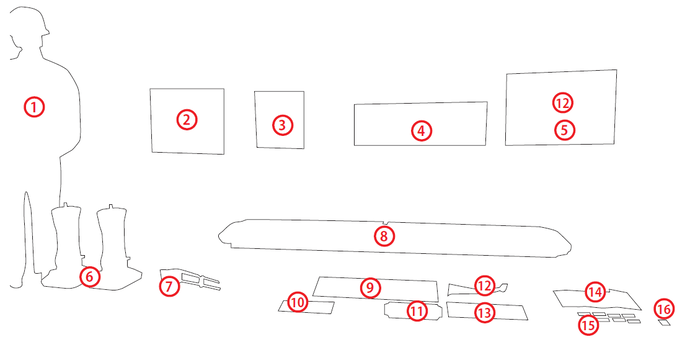
1: Matto Rail Yard Work Clothes from the Japan National Railways Era
Exhibited is an example of the clothes worn by workers of the Matto Rail Yard before the privatisation of the country’s railways. The Kanazawa Rail Yard was founded with 76 personnel in February 1897. With the expansion of the Hokuriku Main Line, and increase in the number of trains, the number of personnel increased rapidly, with 466 employed in 1918. After the relocation of the rail yard to Matto, personnel numbers rose to 699 in 1943 before slowly decreasing. In 1996 there were 270 employees.
2: Image of a train being repaired at the Matto Rail Yard, approximately 1975.
3: Newspaper Article about the Construction of the Matto Rail Yard
In November 1927 it was decided to move the Kanazawa Rail Yard to Matto. The town of Matto decided to buy the land and donate it to the Ministry of Railways, but as a result the finances of the town became tight and disorder worked its way into the town administration. Construction began in 1916 and was finished in August of 1935. In October of the same year, the transfer was complete.
4: DD1612 Diesel Engine
This is the head mark of a DD16 series diesel engine. The DD16 began being used in 1971, and was small and lightweight with a strong 1,100 horse power engine. It was used throughout the country from the 1970s through the 1980s. All the cars were discontinued before the privatisation of the National Railway.
5: Old Train Tickets from the time of the National Railway
These train tickets – which are from before the privatisation of the National Railway – were sold at a ticket booth at Matto Station until the 30th of March, 1986. From the 10th of March of the same year, automatic ticket dispensers were installed, and from the 30th seat reservations could be made using an automated machine. Thus, the sale of tickets via the ticket booth were ceased.
6: D51775 Steam Train Safety Valve
The D51775 was the last steam train to be repaired at the Matto Rail Yard, in 1969. At the time the safety valve was replaced, and the old one exhibited here was preserved. When the D51775 left the rail yard, a commemorative ceremony was held as the last steam train was seen off.
The D51775 is currently being stored by the side of Kiso-Fukushima Station in Nagano Prefecture.
7: Matto Rail Yard Opening Commemorative Paper Weight
This device was made in commemoration of the opening of the Matto Rail Yard in 1935. The device stamped the words “Matto Rail Yard Opening Commemoration” onto a paper weight decorated with the Ministry of Railways mark.
8: 681 Series “Thunderbird”
Operation: Between Toyama / Wakura Onsen and Osaka
The 681 Thunderbird was the first limited express train introduced by JR West. It was manufactured as a successor to the 485 series “Raichou” (meaning “thunder bird”) and “Super Raichou” limited express trains that were used on the Hokuriku Main Line. A prototype of the 681 Thunderbird was introduced in July 1992, and by March 2002 all cars owned by JR West were updated. The trains were manufactured by Kawasaki Heavy Industries, Kinki Sharyo, Hitachi, and Niigata Transys, but the production has since been discontinued due to the introduction of the new 683 series. Since 2015 a further renewed 683 Series was introduced, and the Thunderbird ran from from Osaka to Kanazawa until 2024. Today it runs between Osaka and Tsuruga.
9: D51 Steam Train Plate (D51168)
This is the plate from the front of D51 steam train number D51168. The D51 steam train is a tender type steam train (coal-car) designed by the Ministry of Railways, of the former Japanese National Railways. It was mainly used for the transportation of freight, and was the most mass-produced steam train in Japan, making it the most representable steam train. It gained the nickname deko-ichi or dego-ichi after the Japanese pronunciation of D51, which in turn became synonymous with steam trains as a whole.
10: Japan Railway Institute, Kanazawa Rail Yard Plate, 1918
This is the rail yard plate from the former Kanazawa Rail Yard. By the time the Hokuriku Main Line opened to Uozu (Toyama Prefecture) in November 1908, it became indispensable to have a factory for maintaining train cars, so the construction of the Kanazawa Rail Yard for the maintenance of rolling stock along the Hokuriku Main Line became an urgent matter. In May 1909, although the scale was reduced due to cost cuts, the rail yard was established as the Kanazawa Transport Office’s Kanazawa Rail Yard. In February the following year (1910), the Kanazawa Rail Yard became independent based under the government system of the Chubu Railway Administration Bureau. The rail yard mainly dealt with steam trains, passenger cars, and freight cars used on the Hokuriku Main Line at the time. However in 1918 the repair of steam trains was moved to the Hamatsu Rail Yard, so the Kanazawa Rail Yard became focused on passenger and freight cars. On the other hand, in 1912, with the opening of the Hokuriku Main Line between Maibara and Naoetsu, the Kanazawa Rail Yard workload increased, and its size was unable to facilitate. Thus in 1935 it was decided to move the rail yard to Matto, and the Kanazawa Rail Yard closed having been used for close to 30 years.
11: Japan Railway Institute, Kobe Rail Manufacturing Plant Plate, 1910
The Kobe Plant was the second rail yard plant in Japan (after Shinbashi in Tokyo), and was built in 1874. Until the Railway Nationalization Act in 1906, there were only three rail yards in Japan, including the third in Nagano. It was abolished in 1915.
12: Late Meiji-Era Luxury Car Luggage Wrack Holder
The Oroha 8230 was an express train made in the Shinbashi Plant in 1909. These luggage wrack holders were thought to be used in the luxury cars.
13: 2400 Steam Engine Plate
The 2400 Steam Engine is a German-made engine that was used throughout the Meiji Period (1868 - 1912). It boasted strong horsepower, and the average engine was used continuously for approximately 70 years. It was eventually discontinued in 1961, and in the same year one was dismantled at the Matto Rail Yard. This is the plate from that engine.
14: Timetable for the Hokuriku Line, August 1949 Edition
15: National Railway Train Ticket
16: Shoukin Line Return Ticket (Used), approximately 1930s-40s.
P8: The Birth of Hakusan City
In February 2003, while the “Great Heisei Consolidation” was being promoted nationwide, the Matto-Ishikawa Area Merger Council was established, and preparations began for the development of a new city that merged Matto City with 2 towns and 5 villages of Ishikawa District (Mikawa Town, Tsurugi Town, Kawachi Village, Yoshinodani Village, Torigoe Village, Oguchi Village, and Shiramine Village). In September of the same year the name of the new city was petitioned from residents, ensuring that it did not contain parts of any of the current city/town/village names. In the end the name “Hakusan City” was decided, and the merger talks continued smoothly. In June 2004, the merger agreement was signed, and in February 2005 Hakusan City was officially established according to the merger.
The area of the city is 755.17km2, which makes up approximately 18% of the total area of Ishikawa Prefecture. It is the largest municipality in the prefecture, and approximately 3/4 of the city is comprised of forested mountains. It has the second largest population in Ishikawa Prefecture, after Kanazawa City, and has become a leading municipality within the Prefecture.