
 サイトマップ
 各課のご案内
 施設のご案内
 お問い合わせ
The Appearance of Kaihatsu-Ryoshu Lords
In the following exhibition you will find stickers on each panel, corresponding to the relevant sections below.
Feel free to tap the section(s) you wish to view from the menu above.
J1: The Appearance of Kaihatsu-Ryoshu Lords
Disturbances in local politics increased social unrest causing fires and theft. In response, officials of the national government, district magistrates, and wealthy estate owners (people who owned their own rice fields) began to form small groups of samurai warriors to help them maintain public order, and protect farmers and the land under their control.
At the Miura Site (early Kofun to late Heian Period), green-glazed ceramics, grey-glazed ceramics, white porcelain, celadon porcelain, as well as iron slag and bellows related to field smithing were found within parts of the excavated stilt houses.
These artefacts are thought to have been left behind by the kaihatsu-ryoshu lords (owners of developed farmland) who led small samurai groups.
J2: Spread of Miura Upper Style Pottery
From the end of the 9th century, the production area of sue pottery was shrinking, and tableware was dominated by hajiki pottery with a blackened inner, followed by standard hajiki pottery. Hajiki pottery from the late 10th to early 11th century is called “miura upper style” named after the upper layers of the Miura Site where they were first discovered.
It’s unsure whether or not the soft hajiki pottery was used as a staple food utensil, and many assume that wood products were used more commonly.
Pottery from the Miura Site covers from the beginning of the Kofun Period, through to the latter half of the Heian Period. The layers of the site are split into three groups: the lower layer (4th century), the mid layer (9th century), and the upper layer (11th century). As a result the site serves as a reference for ancient pottery research.
Pictured on the wall is a diagram of the layers within the Miura Site. From top to bottom they are as follows: Embankment layer, topsoil layer, yellow-grey clay layer, the upper layer (black, clay, organic soil), the mid layer (black-brown, clay, organic soil), the lower layer (light grey, clay, sandy organic soil), yellow-grey gravel and clay-sand layer, and dark grey sand layer.
J3: Production Area of Hajiki Pottery
The location of where hajiki pottery was fired is unknown, and currently there are a few theories.
For example:
1) Made close to the production area of sueki pottery
2) Made in typical villages
It’s an important problem in understanding society of that time.
In some hajiki pottery, sea sponge spicules (small spines) are included, and may provide clues to their production
J4: Displayed Artefacts
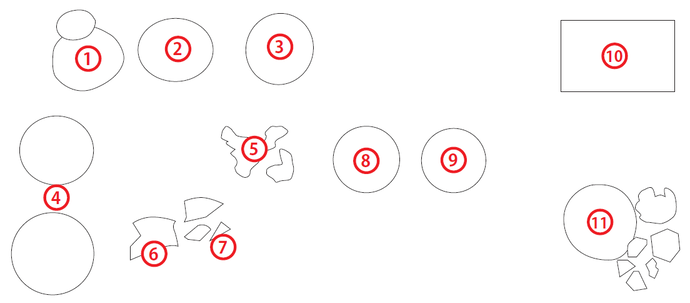
1: Green Glaze Jar with Handle
2: Green Glaze Plate
3: Black Hajiki Pottery Dish with Stand
4: Ash Glaze Plates
5: Lace Coral
Pocillopora damicornis
This species of coral cannot be found north of Kyushu along the Sea of Japan coastline.
These corals were discovered in the Kitayasuda Site, meaning that there was an exchange
between the people of Kyushu or people along the Pacific Ocean coastline.
6: Celadon Dish
Fired in the Esshu Kiln of China.
7: Green Glaze Plate
8 - 9: Hajiki Pottery Small Dish and Stand-less Dish
10: Stone Mound
Prefectural Historic Site
The site consists of the four corners of a flat square burial mound, with five standing stones in the centre. The total length of the central stone is 267cm, with the other stones placed precisely at North, South, East, and West of the central stone. Because of this, it has attracted attention as a transport-related site, associated with the ancient Hiraka Port and Hiraka Station.
11: Earthenware Bowl
Age: Late 10th to early 11th century
These Hajiki Pottery earthenware bowls were excavated from the Ishinokizuka Burial Mound (Prefectural Historic Site).