
 サイトマップ
 各課のご案内
 施設のご案内
 お問い合わせ
Yokoe-no-Sho (Estate of Todaiji Temple) and the Collapse of the Ritsu-Ryo System
In the following exhibition you will find stickers on each panel, corresponding to the relevant sections below.
Feel free to tap the section(s) you wish to view from the menu above.
I1: The Establishment of Yokoe-no-Sho
As the Ritsu-ryo system became more concrete, the Imperial Court began many big projects such as building the capital and the Great Buddha in Nara. At the same time, war was occurring over the control of Northeast Japan, and the burden on farmers was ever increasing. Farmland fell into ruin, and commoners who were unable to pay taxes fled. With utilized land diminishing, the Imperial Court began allowing private ownership to those who reformed these wasted lands. Thus many wealthy people such as the family of the emperor, and government temples were able to obtain land. This is the beginning of the existence of sho-en – private estates.
Yokoe-no-Sho is one of these private estates, located in north Hakusan City. It was established as a rice field gifted to the Imperial Princess Asahara in approximately 796. Afterwards, Princess Asahara passed away in 817, and according to her will, her mother Princess Sakato presented the land to the Todaiji Temple of Nara.
I2: Construction of Yokoe-no-Sho
The Yokoe-no-Sho Estate composed of over five buildings built around the three sides of a central courtyard. It’s believed that the main house was used for administration and meetings. It was a splendid building, with flooring, a hipped roof, and eaves on the southern side. There is also a side house thought to be used to lodge messengers (lowly bureaucrats) and engineers dispatched from Todaiji Temple, as well as warehouses used to store things like farm tools. It is believed that every autumn, harvested rice was collected in the front courtyard.
I3: Management of Sho-en Estates
The early Yokoe-no-Sho Estate (also known as the Estate of Todaiji Temple) was established to cover the enormous maintenance costs of the Todaiji Temple in Nara, and it stretched over approximately 3,000 hectares.
These initial estates were developed as national projects, with the active cooperation of local feudal families. Cultivation seems to have been carried out under old farming contracts with surrounding farmers.
However, the development of these estates often conflicted with local interests, such as causing problems with irrigation.
I4: Bokusho Pottery and Inkstones
What is the difference between an estate and a standard village? You could almost say the answer is written in “stone.” The need for writing documents at the time was typically restricted to government offices such as provincial and district offices. But estates also had to prepare various documents such as an annual rice cultivation plan, rice field plans, and post-harvest income and expenditure statements. Therefore literate people who could write these documents were present at the estates.
At Yokoe-no-Sho, many earthenware items containing writing and symbols written in ink have been excavated – these are called bokusho pottery. One of these contains the word “miyake” meaning the estate management office. The inkstones used to produce the ink have also been discovered, some of which are circular, and some re-utilized earthenware. It is thought that a scribe lived in the manor and used these inkstones to write.
I5: The Collapse of Yokoe-no-Sho
In 1985, a group of ancient warehouses built at regular intervals were discovered in the east of the Yokoe Ironworks Complex. In addition, burnt rice still attached to the stalk were also discovered from a warehouse that had been damaged in a fire, suggesting this was a rice warehouse. In the excavation that followed, evidence of more than 50 warehouses and buildings were discovered lined up in a U or O shape, over a large area of land approximately 440m2.
Artefacts show that the management of Yokoe-no-Sho grew rapidly at the start of the 9th century, however was at a standstill by around the end of the century. Following a fire the destroyed buildings were not rebuilt, and before long Todaiji Temple decided to abandon the estate.
Pictured is the remains of one of the warehouses, and a diagram of a posthole.
I6: Displayed Artefacts
The artefacts discovered at the Yokoe-no-Sho site include earthenware remains of a tile pagoda, an incense burner with fine openwork carvings (green-glaze pottery), celadon (green glaze) pottery from China, and earthenware with the word “temple” written on it. These indicate that a temple was located by the manor. A collection of these artefacts are on display, and described below.
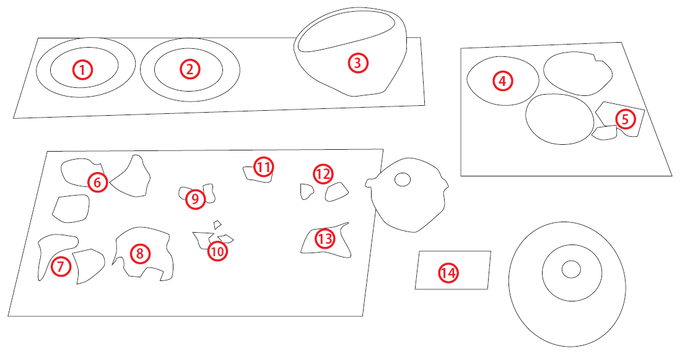
1 - 2: Green Glazed Ceramic Ware
Age: Heian Period (794AD to 1185AD)
A large standing dish with three legs. Excavated from the Yokoe-no-Sho site. It is a high quality Buddhist ware made in Kyoto using green glaze.
3: Green Glazed Pottery Teppachi
Age: Heian Period (794AD to 1185AD)
A teppachi – a bowl used by monks for begging for alms (money or food). Excavated from the Yokoe-no-Sho site. It is a high-quality Buddhist ware made in Kyoto using green glaze.
4: Plate
A green glaze plate made in Kyoto.
5: Saucer
A green glaze saucer placed under bowls, used in Buddhist alters.
6: Tiled Pagoda
These earthenware tiles are made to look like a wooden 5-story pagoda.
7: Earthenware Pagoda Finial
Thought to have been used on the top of a small pagoda.
8: Nara Sansai Kasha Incense Burner
Age: Nara Period (710AD to 794AD)
It is a large incense burner used in Buddhist rituals at temples.
9 - 13: Esshu Kiln Celadon
Since the time of the Han Dynasty, celadon has been made in Zhejiang Province, China. Those made in the Tang Dynasty’s official Esshu Kiln are said to have the highest quality. Through trade, a small amount of this celadon made it to Japan through the Korean peninsula.
10: Green Glazed Earthenware Incense Burner Lid
Age: Heian Period (794AD to 1185AD)
It is a high-quality green glazed Buddhist ware made in the Owari Domain. It is decorated with openwork carvings.
11: Belt decoration.
12: Earthenware with the kanji for temple written.
13: Buddhist ware celadon lid.
14: Carbonised rice
Excavated from a warehouse discovered at the Yokoe no Sho Site. It is thought to have been a warehouse for storing rice. The rice has been carbonised due to a fire. The brown parts are the ear of the rice plant.
I7: The Collapse of the Ritsu-Ryo System
The Transformation of Villages
The latter half of the 9th century to the latter half of the 11th century is a time where the Emperor-centred Ritsu-Ryo Nation gradually collapsed due to regent politics.
At the Kitayasuda North Site, stilt houses thought to be the residences of influential people of the village were discovered. Stilt house #208 was built using 16 pillars over roughly 15m x 8m, with eaves on the west side, and contained inside was a scale and contents comparable to the royal residences of provincial and district offices and estates. It shows that by this time, typical villages under the Ritsu-Ryo system had transformed into villages with a wealthy person, who would later be called a village head.
Pictured is the remains of stilt house #208.
I8: Valuable Treasures
Stilt house #208 and six other buildings were arranged in a U-shape.
From these buildings, a number of relics were excavated. From the postholes of a building thought to be a side building, a green-glazed ceramic jar (with handle), and a large amount of green-glazed ceramics and grey-glazed ceramics were discovered. From a large water channel on the east side of the buildings, many grey-glazed ceramics and Chinese celadon porcelain, bokusho pottery, and corals were found, and from the east of the water channel a copper seal was discovered.
Pictured is a diagram of the buildings and water channel.
I9: Displayed Artefacts
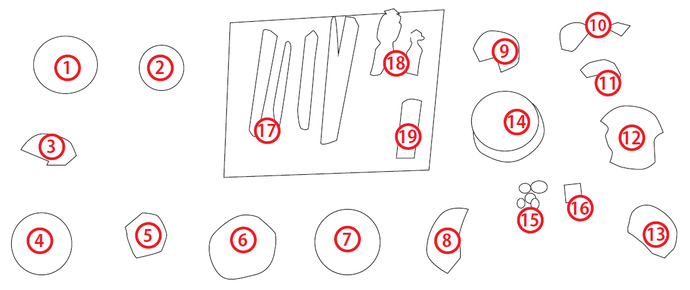
1 – 13: Bokusho Pottery
Earthenware with letters and symbols written in ink, are called Bokusho Pottery, and have been excavated from Nara and Heian Period sites. Not only were they found in temples and estates, but also from normal villages, meaning that writing was beginning to permeate into the lives of every day people.
1: A woman’s name “Maka”
2: “Girl”
3: An important person’s name “Azumi”
4: “Inside”
5: A building name
6: A letter used in Buddhism
7: A letter indicating the village leader
8: The number 80
9: An arrow symbol
10 – 11: “Medicine” – A letter for a charm
12: The number 10,000
13: The name of a building.
14: Sueki ware. Ceramic inkstone.
15: Wadoukaichin Coins
Age: Nara Period (710AD to 794AD)
Wadoukaichin is the first form of currency used in Japan. It hosts the kanji “Wa” which represents Japan. These pieces were not used as currency but for land reclamation rituals. Because strings were often threaded through the holes, seven coins were excavated overlapping each other.
16: Seal
Age: Heian Period (794AD to 1185AD)
From the Kitayasuda North Site. It is a bronze seal containing the auspicious character fuku “luck.” It is not a government seal, but rather believed to be the private seal of an influential person. This is the only seal of its kind excavated in the Hokuriku area. The seal is 3.2cm x 3cm with a height of 3.7cm.
17 – 19: Artefacts from the Yokoe no Sho Main Building Site
17: Fire-starting Sticks
18: Human Shaped Wood. Used in purifying rituals.
19: Name Boards. Wooden boards with people’s names written on them.