
 サイトマップ
 各課のご案内
 施設のご案内
 お問い合わせ
Samurai Period
In the following exhibition you will find stickers on each panel, corresponding to the relevant sections below.
Feel free to tap the section(s) you wish to view from the menu above.
K1: Local Samurai History
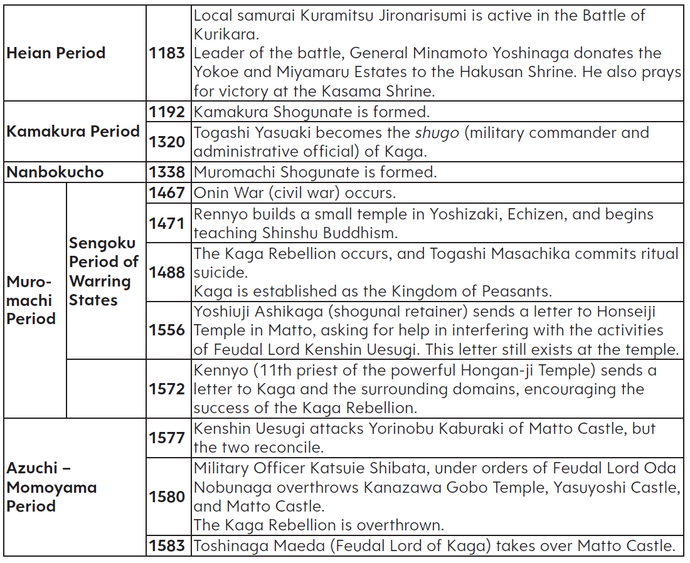
K2: Matto in “Genpei’s Stories of Success and Decline”
We can learn fragments about Matto during the period of the Genpei war, through representative military historic records such as “Tales of the Hei Family” and “Genpei Stories of Success and Decline.” In 1180, when Minamoto no Yoshinaka raised an army to drive out the Hei clan, the Kuramitsu clan of Matto joined Yoshinaka’s army. There are also writings about the nearby towns Yokoe and Miyamaru.
K3: Displayed Artefacts
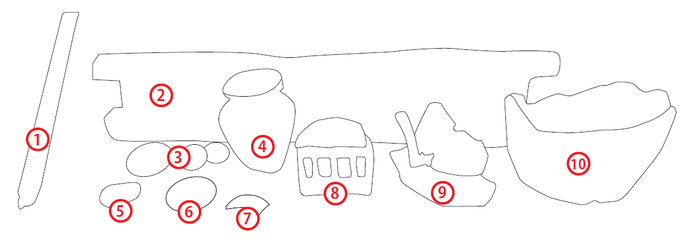
1: Monoimi Fuda
“Mourning Cards”
Age: Kamakura Period (1185 – 1333)
Excavated from the bottom of a well at the Miyanaga Hojikawa Site. It is a mourning card with a purification spell written on a piece of wood. It contains the phrases kyuu nyoritsuryou – a phrase with Confucian roots roughly meaning “fast and by the law” which came to be used in exorcisms. It is thought to be placed in the house of a deceased to purge misfortune. The numbers 9 and 81 are written both right-side up and upside down to represent eternity.
2: Wooden Well Frame
Age: Muromachi Period (1336 – 1573)
3: Hajiki Pottery Plates
Age: Kamakura Period (1185 – 1333)
4: Pot Fired in Kaga
Age: Kamakura Period (1185 – 1333)
5: Lacquerware Dish
Age: Sengoku Period (1467 – 1615)
6: Seto Ware Ash Glaze Plate
Age: Sengoku Period (1467 – 1615)
7: Celadon
Age: Kamakura Period (1185 – 1333)
8: Anka Heater
Age: Sengoku Period (1467 – 1615)
Excavated from the Miyanaga Hojikawa Site. It is a stone heater made in southern Kaga. It was used by burning charcoal inside of it.
9: Tea Grinding Stone
Age: Sengoku Period (1467 – 1615)
10: Stone Bowl
Age: Sengoku Period (1467 – 1615)
It is possible to have been used as a fire basin.
K4: Medieval Artefacts
Medieval Artefacts
One of the medieval sites excavated in the city is the Kenzaki Site.
The Kenzaki Site was excavated in 1985, and a square ditch with a length of 10m was discovered surrounding a pit. From the pit and ditch, bone fragments, tomb stones, and a memorial gorinto (five-ringed tower) were unearthed.
These are Muromachi Period (1336-1573) artefacts, and the buried person is thought to be a powerful feudal lord who controlled the area around Kenzaki.
Pictured is a diagram of the Kenzaki Site, with the location of discovered artefacts in green.
Itabi Stone Monuments
Age: Sengoku Period (1467 – 1615)
These are called itabi and are stone monuments built in memory of a deceased.