
 サイトマップ
 各課のご案内
 施設のご案内
 お問い合わせ
The Yayoi Period
In the following exhibition you will find stickers on each panel, corresponding to the relevant sections below.
Feel free to tap the section(s) you wish to view from the menu above.
F1: The Yayoi Period
Around 300 BC, a new culture appeared in northern Kyushu, which suddenly spread east throughout Japan. This period is called the Yayoi Period (300 BC – 300 AD).
The Yayoi culture is characterised by rice farming, and the introduction of iron, which was introduced through China and the Korean Peninsula. It is around this time that rice cultivation began within Japan. In Hakusan City, rice farming began at the start of the mid-Yayoi Period.
F2: Propagation of Rice Farming
Rice farming originates from India and Southeast Asia, but the route that this culture took in order to reach Japan is unknown. The most prominent theory is that a variety of rice that was developed in the south coast of China spread to the south of the Korean Peninsula before then being transmitted to Japan.
From then, rice farming spread suddenly within the western region of Japan, and by the end of the early Yayoi Period (100 BC), it had spread as far as Ise Bay in Mie/Aichi Prefecture on the Pacific Ocean side, and the Wakasa Bay coastline in southwest Fukui Prefecture on the Sea of Japan side. This is because the environment of western Japan was ideal for growing rice. By around 100 AD it had spread to northeast Japan, and finally spread throughout all of Japan (excluding Hokkaido) by the end of the Yayoi Period (300 AD).
It is thought that rice farming spread to the local area here at the start of the mid-Yayoi Period. At first the farming know-how was immature, so villages were built in the lowlands where groundwater naturally welled out, and rice was grown there. The Hattanaka site from the mid-Yayoi Period is one of these villages, however the shapes and patterns of earthenware from the site contain features leftover from the Jomon Period.
F3: Displayed Artefacts
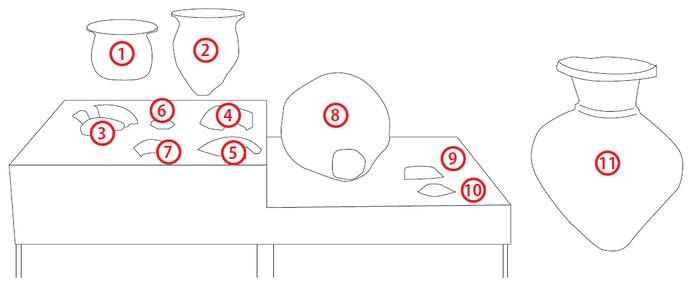
Kame Jars
Comb-Pattern (1, 3, 6, 7)
These jars are from the mid-Yayoi Period. Most Yayoi Period jars don’t have patterns, but these pots contain detailed patterns drawn using combs. It seems that this pattern was popular at the time. Excavated from the Nomoto Site.
Special Rim (2, 4, 5)
These jars are from the mid-Yayoi Period, and exhibit a wavy pattern on the rim, which similar to Comb-Pattern jars, is one of the specialties of the patterned artefacts from the time.
8: Deer Painted Pot
This is a kame pot, from the Asahi Site, depicting two deer. They both contain antlers so are thought to be males, however the right deer appears to be younger.
9: Stone Knife
A tool used to cut stalks of rice. Excavated from the Yokoe Site.
10: Bundo-Shaped Stoneware
Stoneware shaped like bundo – traditional Japanese weights, which are shaped like a circle with two holes in the sides. Excavated from the Yokoe Site.
11: Pot
Excavated from the Hatta Site.
F4: A Bead-Making Village
By the end of the Yayoi Period, rice farming had finally made its way to, and taken a foothold in the Hokuriku region (the region encompassing Fukui, Ishikawa, and Toyama Prefectures). Thanks to the financial stability that rice farming brought, bead-making began being developed in Hokuriku. Raw stones were carved to make jewellery such as tube-shaped beads and comma-shaped jewels. Artefacts relating to bead-production have been discovered in the Hatta Kobuna Site from the late Yayoi Period. At this site, finished and unfinished beads, as well as shavings from the beads were discovered in a pit dwelling with a size of about 7m x 8m. Furthermore, holes and grooves were found near the wall, further suggesting that this was a dwelling that made beads. It is believed that the beads were worn by the village chief and their close relatives.
Bead Production Illustration
Rock is broken into small pieces → adjustment → delicate carving → finished!
F5: Changes in Earthenware
From the end of the Yayoi Period into the Kofun Period, an extremely large societal change occurs. This is because of a movement where village chiefs repeatedly compete for areas with independent water systems, eventually forming their own clan-nations.
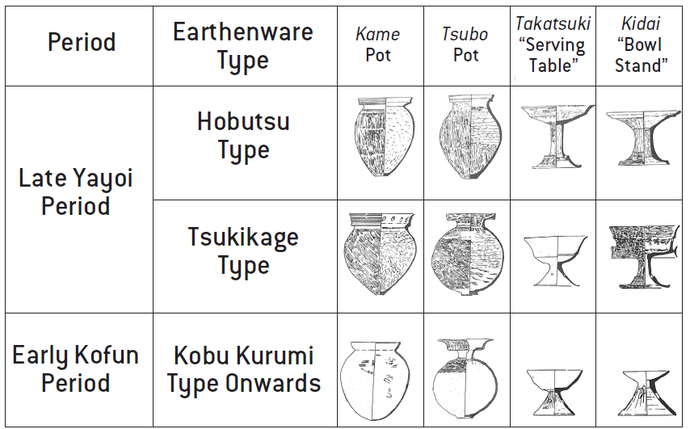
This movement is represented in earthenware and their patterns. The change from village to clan-nation is seen in the change of the following earthenware: Hobutsu Type → Tsukikage Type → Kobu Kurubi Type.
Hobutsu Type earthenware, standardized from the earthenware discovered in the nearby Hobutsu Site (late Yayoi Period), has strong localised characteristics, whereas Kobu Kurubi Type earthenware has strong effects from the nearby Kinki Region (Kyoto, Osaka and surrounding prefectures). This suggests that the chief of the Hokuriku Region slowly fell under the jurisdiction of the Kinki Region chief.
F6: The 21st Tomb of the Ichizuka Site
From the late Yayoi Period to the end of the Yayoi Period, in addition to typical burial mounds such as houkeishukobo (square-shaped burial mounds surrounded by a pit), new larger burial mounds with unique local characteristics began appearing throughout western Japan, and were clearly the tombs of chiefs.
Although the 21st Tomb of the Ichizuka Site does not have typical hari-ishi (stones used to adorn the floor and/or walls of a tomb), it has the form of a yosumitosshutsugata funkyubo (four-corner burial mound) similar to the type developed in the San’in region of western Japan, and is much larger than the similar houkeishukobo type.
At the time of the excavation the main part of the tomb had already been flattened, but from the surrounding trenches a large number of pots were excavated, including jars and vases with holes intentionally made in the bottom. Some of these pots are exhibited here.
Eventually through the influence of the Yamato Court in the following Kofun Period, these types of burial mounds were no longer made, and instead were replaced with a long, round type of burial mound called zenpokoenfun.
The map indicates in green the spread of the San’in region burial mound, and in yellow the houkeishukobo burial mound.
F7: Displayed Artefacts
1: Bead Making Artefacts from the Asahi Site.
At the Asahi Site, which covers the late Yayoi Period through to the Kofun Period, a residence was found to have been producing beads. These artefacts are the remains of the bead making process that were discovered there.
The process is as follows: (1) Original stone material (2) Shaping (3) Drilling a hole through the centre (4) Polishing. The last beads on the right are finished glass beads.
2: Rock Flakes
Many of these rock flakes were found in the residence where beads were made. They are the leftovers of rock chipped away when carving beads.
Yayoi Pottery
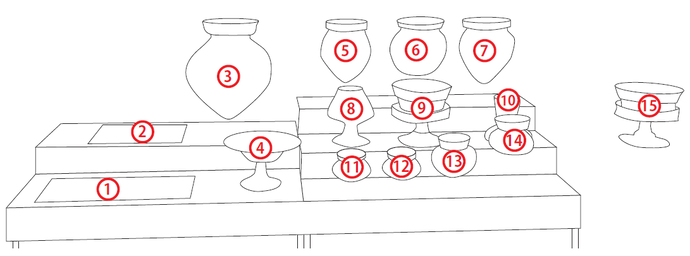
These are all “Tsukikage Type” pots from the late Yayoi Period, excavated from a tomb at the Ichizuka Site.
3: A large pot with stepped rim.
4: A tall serving bowl
5 - 7: A stepped pot with an engraved rim
8: Neckless vase with attached base (wine glass shape)
9: Stand with decorated edges and carved holes
10: Long necked vase
11: Small pot with stepped rim
12: Small pot with stepped rim, and holes punched in the base
13: Small pot with stepped rim
14: Pot with stepped rim and base
15: Stand with decorated edges and carved holes. Excavated from the Takematsu Site. Hakusan City Designated Cultural Property.