
 サイトマップ
 各課のご案内
 施設のご案内
 お問い合わせ
The Ritsu-Ryo Period
In the following exhibition you will find stickers on each panel, corresponding to the relevant sections below.
Feel free to tap the section(s) you wish to view from the menu above.
H1: The Ritsu-Ryo Period
While unification under the Yamato Court continued, in between all this, powerful clans were repeatedly fighting for power, with the rebellious activity becoming increasingly conspicuous. Among this, Prince Shotoku, Prince Nakano-oeno-oji, and Nakatomi no Kamatari began trying to arrange a political class system and make a nation centred around the Emperor. Their efforts paid off with the Taika Reform in the year 645, which resulted in a centralized nation based on the new “Ritsu-ryo” system. The Ritsu-Ryo Period is an informal period that covers the Nara Period (710 – 794), and the Heian Period (794 – 1185).
The local Matto area saw increased development through the Nara and Heian Periods.
H2: An Ancient Village
During the Ritsu-Ryo Period, commoners who registered in the national family register were given fields called kubunden to grow crops. In exchange for use of the fields, taxes such as rice tax, forced labour (or an exemption tax), and textile tax had to be paid to the government, making the lives of commoners very difficult.
The Kitayasuda North Site (late Kofun to Heian Period) was excavated before the construction of the Chiyono Newtown Estate, and gave a lot of insight into the structure of the village at the time. Approximately 200 pit dwellings and stilt houses were built on a relatively tall place on the banks of a river, showing the change in the construction of houses from pit to stilt. Furthermore, earthenware and iron farm tools, as well as the clay used to make earthenware, and bellows used to make iron were unearthed. It is thought that farm tools and eating utensils were made in the village.
The picture and illustration show the Kitayasuda North Site. The red dots indicate the pillars of stilt houses (with the red lines showing where the walls would have been), and the blue squares indicate pit dwellings.
H3: An Ancient House
Let’s have a close look at the two kinds of houses discovered at the Kitayasuda North Site.
Pit Dwelling (based on pit dwelling #110)
An area of 5m x 4m is dug out, and wall boards are placed in a groove dug around the pit. On top a thatched roof is built, and the dirt floor is covered with grass or a woven mat. Cooking is undertaken in a designated cooking pit built into the floor, and a storage pit used to store food is next to it.
Stilt House (based on stilt house #150)
Twelve pillars with diameters of approximately 20cm are placed around a 5m x 7m area. The roof is supported by the pillars, and is thought to have been thatched or boarded. The walls are boarded, however there are no postholes discovered to support a boarded floor, so the floor was likely dirt. Stilt houses were initially used as warehouses to store rice or as houses for powerful clan members to live in, however before long, commoners also began living in these kinds of houses.
H4: Displayed Artefacts
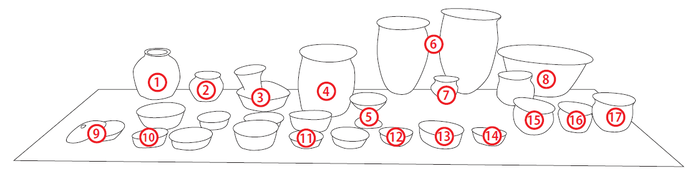
1 – 2: Pot made from sueki ware.
3: Flattened long-neck jar made from sueki ware.
4: Long pot made from hajiki pottery.
5: Tall shallow bowl made from hajiki pottery.
6: Long pots made from hajiki pottery.
7: Pot made from hajiki pottery.
8: Large pot made from hajiki pottery.
9: Dish and lid made from sueki ware.
10: Dish with base, made from sueki ware.
11: Dish made from sueki ware.
12: Dish made from hajiki pottery.
13: Dish made from red hajiki pottery.
14: Blackened dish made from hajiki pottery.
15 - 17: Small pot made from hajiki pottery