
 サイトマップ
 各課のご案内
 施設のご案内
 お問い合わせ
The Jomon Period
In the following exhibition you will find stickers on each panel, corresponding to the relevant sections below.
Feel free to tap the section(s) you wish to view from the menu above.
E1: The Jomon Period
Approximately 10,000 years ago the last ice age ended, and Japan’s ancestors began their lives among a changing environment, using an abundant variety of earthenware. This period is called the Jomon Period (10,000 BC to 300 BC) – named after the jomon cord used to decorate the majority of earthenware used during this time.
With the exception of parts of northern Kyushu (the southern island of Japan), rice was not cultivated during this period. The Jomon people living in this area were hunter gatherers, travelling around the plains in search of prey.
E2: Jomon Period Lifestyle
The lifestyle of people in the Jomon Period was very harsh due to the constantly changing natural environment. People lived by moving around in search of food, gathering plants according to the seasons, catching fish and shellfish, and hunting. In such an unstable life with frequent food shortages, there was no such thing as rich and poor. Furthermore, there was a constant risk of injury or illness, and as a result the average life expectancy at the time is thought to have been around 30 years old. People would have respected nature as a God, praying for its blessings. They lived in groups, within pit-like dwellings built beside rivers and forests for convenient fishing and hunting.
E3: Matto Jomon Period Artefacts
Many of the Jomon Period artefacts from Matto are found in and around the underground springs of the area. It is likely that the abundance of water here created a highly suitable place to live.
The Asahi Jomon site from the late Jomon Period was excavated prior to the construction of the Asahi Industrial Park. Artefacts such as earthenware pots and deep pots, earthen earrings, and stone arrowheads were excavated. Other sites known for their late Jomon Period artefacts include Nagatake, Hattanaka, Yokoe, Tokumitsu, Ichizuka, and Fukumasu.
E4: Displayed Artefacts
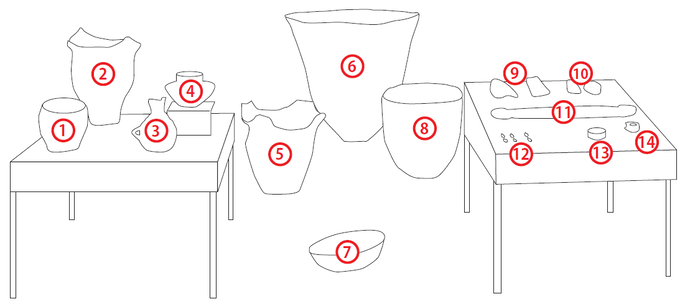
1: Heavy Arch-Pattern Pot. Hakusan City Designated Cultural Property. Excavated from the Kubo Site. From the mid-Jomon Period.
2: Deep Pot. Excavated from the Yoshino Nomitani Site.
3: Jar with Handle. Ishikawa Prefecture Designated Cultural Property. It has a special pattern used in festivals. Excavated from the Hakusan Ueno Site. From the late Jomon Period.
4: Red Jar. Excavated from the Yoshino Tomitani Site. From the late Jomon Period.
5: Deep Pot. Excavated from the Asahi Site.
6: Pot. A thick twisted rope is rolled along the surface of the clay to decorate. Excavated from the Asahi Site.
7: Bowl.
8: Deep Vase. Excavated from the Asahi Site.
9: Lithic Stone Axe. A simple tool made from stone. Rather than an axe, it was likely used for digging through dirt. Excavated from the Asahi Elementary School Site.
10: Polished Stone Axe. A stone axe with a carefully polished surface. The cutting edge was sharp, so it was likely used to cut down trees and branches, and to make materials for building huts. Excavated from the Ichizuka Ominakuchi Site.
11: Stone Stick. An object thought to be used in rituals to heal sickness. This is the thickest of its kind found in Ishikawa Prefecture. Excavated from the Yoshino Nomitani Site. From the mid-Jomon Period.
12: Stone Arrowheads. Stone arrowheads come in various shapes, such as the stemmed arrows on the left, and non-stemmed arrows on the right. Stemmed arrows are easier to use than non-stemmed arrows, and are considered more advanced. Excavated from the Asahi Elementary School Site.
13: Black Lacquer Comb Handle. Excavated from an earthen coffin. It is a rare artefact that shows how lacquer was used even in the Jomon Period. Excavated from the Fukuoka Site. From the late Jomon Period.
14: Earring. An earring made from clay, adorned with string impressions. Excavated from the Asahi Elementary School Site.