
 サイトマップ
 各課のご案内
 施設のご案内
 お問い合わせ
The Kofun Period
In the following exhibition you will find stickers on each panel, corresponding to the relevant sections below.
Feel free to tap the section(s) you wish to view from the menu above.
G1: The Kofun Period
From about 300 AC, all nearby clan-nations quickly started becoming a part of the stronger Kinki Region clan-nation.
Many powerful clans united with the ruler of the Kinki Region, the Yamato Court. When a leader died, the clans built a massive tomb from piled up dirt.
The Kofun Period (300 AD to 700 AD) is represented by, and named after the construction of these enormous keyhole-shaped burial mounds called kofun in Japanese.
G2: Transformation of the Bead-Making Village
Around the time that burial mounds started being built throughout Japan, the Hokuriku region saw a large change in its bead production. The villagers, who had until now made beads for their chief, were now forced to make beads and stone products by order of the Kinki Region ruler, the Yamato Court. These stone products are often seen in graves as grave accessories. A stone product called a kuwagata-ishi (hoe-shaped stone) was found in the remains of a pit dwelling at the Asahi Elementary School Site. It is unknown whether or not the stone was made here, however there were craft-making facilities discovered in the remains. It seems that the influence of the Yamato Court extended even to the production of beads in Matto.
G3: Matto Burial Mounds
There are three known burial mounds discovered in Matto: the Nakasouko #1 and #2 Burial Mound (mid-Kofun Period), the Ichizuka Burial Mound (age unknown), and the Tachi Burial Mound (late-Kofun Period). The Tachi Burial Mound (shown in the exhibition photo, and cross-section diagram) is a lateral hole tomb (shaped like an igloo), which is evidence of Chinese influence. This stone coffin is made from piled up river stones, with a space for the deceased to be laid to rest. Grave accessories such as pots, metal knives, and earrings were placed inside, and by removing the stone at the entrance, further deceased could be added numerous times. Thus the graves were typically used for entire families.
At this time, graves such as “packed tumuli clusters” (numerous small, round burial mounds) and “lateral hole tombs” (cave-like burial mounds) were actively made throughout Japan, showing that some of the peasants who had been under the reign of powerful clans were emerging as influential people with the ability to build burial mounds.
G4: Displayed Artefacts
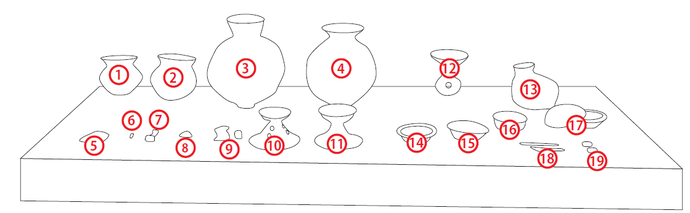
1 – 2: Pots
3 – 4: Pots excavated from the Kitayasuda North Site.
Artefacts from the Asahi Elementary School Site
5: Rock flakes
6: Tube bead
7: Whetstone
8: Spindle Base. Used to weigh down thread.
9: Hoe-shaped Stones. A stone accessory meant to imitate bracelets made from shells.
10 - 11: Tall Pot. Excavated from the Kitayasuda North Site.
Tachi Burial Mound Artefacts
12: Wide-mouthed vase made from sueki ware (a type of pottery)
13: Flattened long-neck jar made from sueki ware.
14 - 15: Dish made from sueki ware.
16: Lid made from sueki ware.
17: Dish and lid made from sueki ware.
18: Tousu – a small knife.
19: Earrings.