 サイトマップ
 各課のご案内
 施設のご案内
 お問い合わせ
Ikko Ikki Throughout Japan
Summary:
Ikki are the name given to armed uprisings that occurred throughout parts of Japan from the 1460s to 1580s. They typically involved farmers (lower-class people) banding together to rebel against upper classes, but were sometimes supported by the upper-class people as well. Ikko Ikki were specifically uprisings formed by followers of the Honganji Temple Jōdo Shinshū sect – who were numerous in the area, thanks to the missionary efforts of Rennyo.
The Period of the Ikko Ikki Rebellions
What is an Ikko Ikki?
Ikko Ikki were armed uprisings and battles led by monks and followers of the Jōdo Shinshū sect of Buddhism that took place from the 1460s to 1580s, mainly in the Hokuriku region (Toyama, Ishikawa, and Fukui Prefectures), the Kinai region (Nara Prefecture), and neighboring provinces.
The Ikko Ikki uprisings were caused from the rapid expansion in the number of Buddhist monks due to the fervent missionary efforts of Rennyo, the 8th head priest of Honganji Temple. Furthermore, the development of self-governing, communal organizations and towns established within the fortified compounds of temples, further strengthened the communal bonds between lower-class people. The uprisings that arose under these factors came in the form of class and power struggles within the political and social situations in each region at the time.
Ishiyama Honganji War Flag (Pictured)
Displayed in the bottom right of the exhibition panel is a war flag. This is thought to be the battle flag for a military ship from the Mōri army that supported the Ishiyama Honganji Temple in the later years of the Warring States Period.
「進者往生極楽」➜Meaning:If they died in battle, they will go to heaven.
「退者无間地獄」➜Meaning:If they ran away, they will not die, but fall down to hell.
Types of Uprisings
There are 4 main types of Ikki uprisings, and they involve “peasants” revolting against parts of society. Originally ikki meant to “share the same path,” but eventually came to mean “to band together” in reference to uprisings.
During the Edo Period (1603-1868), society was divided into four classes: samurai (noble class), peasants (farmers), artisans (craftsmen, artists) and merchants. Therefore, these Ikki, which were uprisings of farmers and village people, became known as “peasant” uprisings. This is also the origin of the naming of the Kingdom of Peasants.
Types of Ikki:
Do Ikki: Revolts conducted by local peasants (farmers).
Ikko Ikki: Revolts conducted by followers of the Honganji Temple Jōdo Shinshu sect of Buddhism.
Kuni Ikki: A large-scale provincial uprising in which the local wealthy people joined with the peasants to revolt.
Hokke Ikki: A revolt that arose in Kyoto under the Nichiren sect of Buddhism.
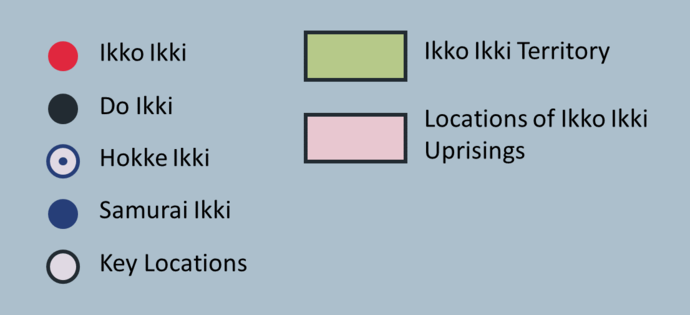
Map: Locations of Ikki Uprisings Throughout Japan
The map in the exhibition shows the locations of various famous Ikki uprisings that occurred during the 15th and 16th centuries.
Map legend: